

It never hurts to learn a bit of the local language! While many employees in businesses that serve tourists will speak some English, the below phrases can help you navigate specific situations.
Comment below with additional
Overview on Japanese Pronounciation
Japanese is relatively easy to pronounce; it does not have tones, the way that Mandarin or Thai do; and words are pronounced exactly as their phonetic spelling suggests, in comparison to English.
- Each vowel has a single, consistent pronunciation; it’s not like English, where each ‘e’ in “freezer” has a different sound
- With the exception of ‘n’, every consonant is followed by a vowel
- Caveat: Many verbs/phrases end in -masu; Japanese people do not pronounce the u.
- There are no silent letters. If you see something phonetically written, it should be pronounced
The vowel pronounciations are:
a, あ, ア like ‘u’ in “us”
i, い, イ like ‘e’ in “hero”
u, う, ウ like ‘u’ in ‘tube’
e, え, エ like ‘e’ in “elevator”
o, お, オ like ‘o’ in “orb”
Basic Phrases
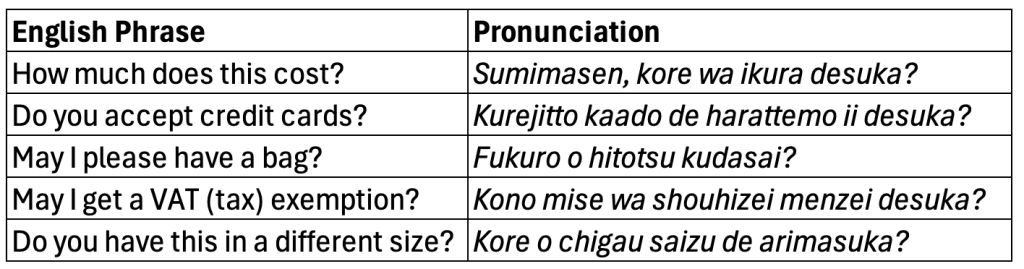
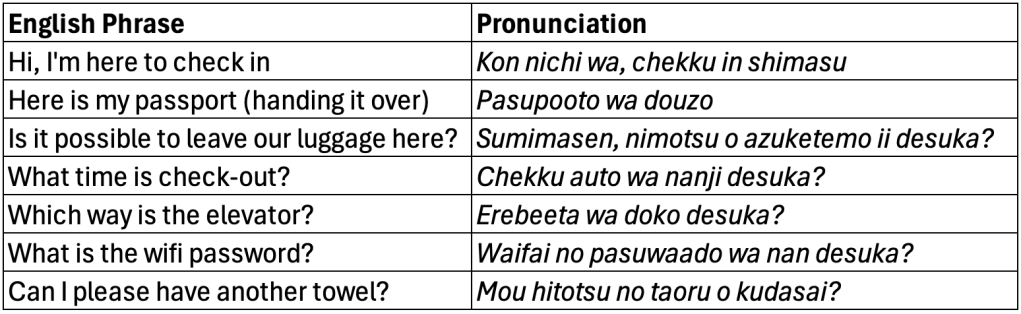
Note: Pronunciation below is designed for phonetic sounds, not romaji; e.g. は is written as ‘wa’, を is written as ‘o’

Shopping
Restaurants

Hotels
 Matt Fuji